An overloaded axle is one of the few mistakes in road freight that gets caught the same day. The truck rolls onto a weighbridge, an axle reads over the limit, and it sits there until the load is corrected. The fine is the small part. The detention, the missed delivery slot, and the report that follows you are what actually cost money.
For a freight forwarder, the trap is that liability doesn't stop with the driver. Under EU rules and the national laws that carry them, the consignor, the loader, and the forwarder can all be held responsible for an overloaded or oversized vehicle, even when none of them touched the wheel. So the limits below aren't only the carrier's problem. They're yours.
This guide sets out the legal weight and dimension limits for standard road freight in the EU, the national specifics that catch people out in Germany, Poland, and Estonia, and a short checklist to run before a truck leaves the yard.
Gross weight, axle loads, and dimensions
Three things decide whether a load is legal: the total weight of the combination, the load on each axle or axle group, and the outer dimensions of the vehicle. The first is easy to track. The second is where most loads fail, because a truck can sit comfortably under the 40 tonne gross limit and still put an axle over its rated maximum when the freight is bunched at one end.
The limits at a glance
These are the standard maximums for international road freight under EU Directive 96/53/EC. Germany, Poland, and Estonia all apply them for ordinary haulage. The national exceptions come after the table.
| Limit | Standard maximum |
|---|---|
| Gross combination weight, standard 5- to 6-axle articulated vehicle | 40 t |
| Gross combination weight, intermodal (container or swap body) | 44 t |
| Single non-driven axle | 10 t |
| Single driven axle | 11.5 t |
| Tandem axle group, semi-trailer | up to 18 t (19 t road-friendly suspension) |
| Triaxle group, semi-trailer | up to 24 t |
| Articulated vehicle length | 16.5 m |
| Road train length | 18.75 m |
| Width, general | 2.55 m |
| Width, refrigerated body | 2.60 m |
| Height (Germany, Poland, Estonia) | 4.0 m |
| Typical payload at 40 t | around 24 t |
A few points the table compresses:
- Tandem and triaxle limits depend on axle spacing. A semi-trailer tandem is capped at 11 t under 1.0 m of spacing, 16 t from 1.0 to 1.3 m, and 18 t from 1.3 to 1.8 m, rising to 19 t with road-friendly air suspension. A triaxle runs 21 t up to 1.3 m and 24 t between 1.3 and 1.4 m.
- The driven axles must carry at least 25% of the combination's weight in international traffic, which is why a trailer loaded too far back can fail even when the gross is fine.
- The 44 t figure is intermodal only. It applies to moves carrying a container or swap body with the right axle count. It is not a free upgrade for general cargo.
There is no harmonised EU height limit. The 4.0 m figure is the national and infrastructure standard in Germany, Poland, and Estonia, and it is the height most bridges and tunnels on those networks are built around.
Where Germany, Poland, and Estonia differ
Germany: longer trucks, not heavier ones
Germany runs the Lang-Lkw scheme, which allows combinations up to 25.25 m on an approved road network, the Positivnetz. The weight limit does not change. A Lang-Lkw still tops out at 40 t, or 44 t intermodal. The extra length buys volume, not payload, which is the detail people most often get wrong. Trucks running on cleaner drivetrains get a small allowance on top, 1 t for alternative fuel and 2 t for zero-emission, to offset the heavier powertrain.
Poland: the axle limit depends on the road
Poland applies the 11.5 t driven-axle limit on motorways, expressways, and the main national network. Step onto lower-class provincial or local roads and the permitted axle load can drop to 10 t, or even 8 t. For a forwarder planning a delivery to a regional site, the legal axle load at the destination can be lower than on the motorway that got you there. Check the road class for the final stretch, not just the trunk route.
Estonia: heavier combinations, and new longer trains
Estonia keeps the 40 t standard and 44 t intermodal limits, but allows more on a special permit, the eriluba: 48 t for a six-axle combination and 52 t for seven axles or more. Since 1 June 2026, Estonia also permits European Modular System road trains up to 25.25 m and 60 t on designated routes, again by permit. Timber haulage gets its own allowance of up to 52 t when the ground is deeply frozen and the bridges on the route are rated for it. If your route or cargo needs one of these, arrange the permit before dispatch. There is no retroactive fix at the weighbridge.
Being under 40 tonnes isn't the same as being legal
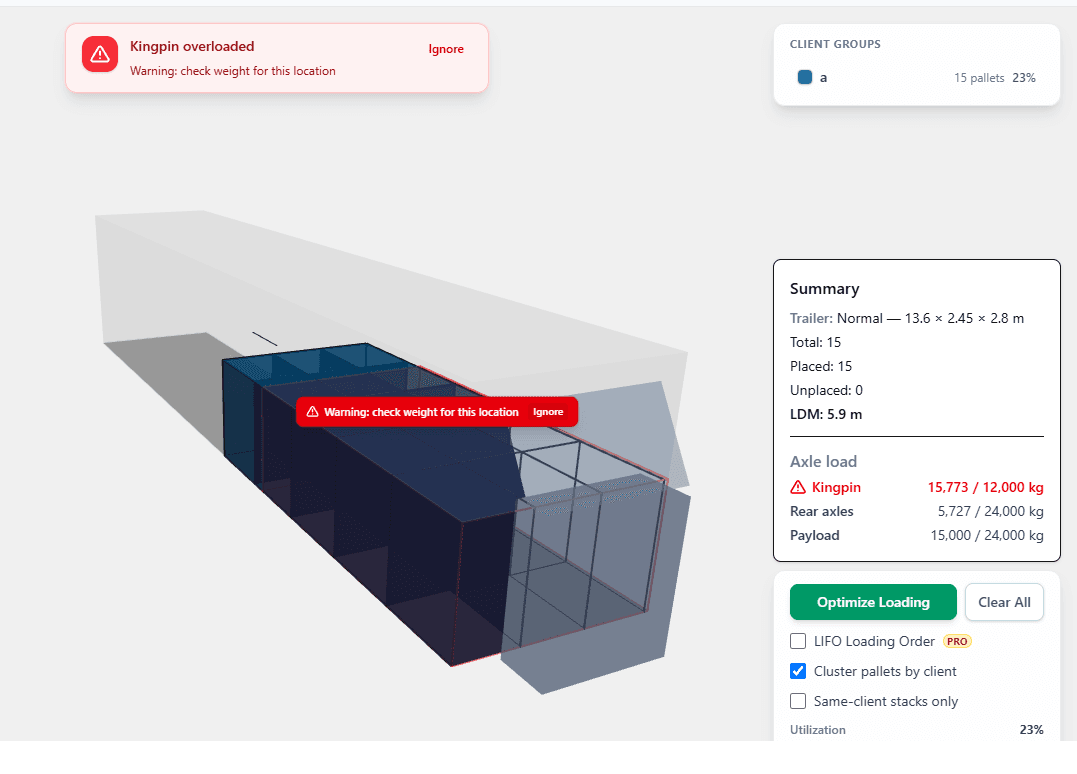
This is the failure mode that surprises people. A load can weigh 24 tonnes, well under any gross limit, and still overload the kingpin or the front of the trailer because too much of the weight sits forward. The fifth-wheel coupling has its own rated limit, and so does each axle group. The only way to know before the weighbridge does is to work out the load on each one while you are still planning the freight.
How PalletPlan keeps a load within the limits
PalletPlan's 3D load planner calculates the vertical load transferred through the kingpin to the fifth-wheel coupling and the load on the rear axle group as you place each pallet, and tracks total payload against the trailer's capacity. When a position pushes the kingpin or rear axles past the limit you have set, it marks that position in red and shows the exact figure, like the 15,773 kg against a 12,000 kg kingpin limit above. You rebalance on screen instead of at the roadside.
The planner places freight with a GRASP-based optimizer that balances space use against keeping each client's pallets together, and it enforces stacking rules automatically, including full footprint support under any stacked pallet. You can lock pallets that are already on the trailer and re-optimize the rest around them, and the LIFO delivery order keeps the first drop nearest the doors so the balance holds as the route unwinds.
For a walkthrough of the planner, see how it works. If you are weighing up whether PalletPlan fits your operation, pricing has the plan details.
Before the truck leaves the yard
Run this before you sign off a load plan:
- Confirm actual pallet weights against the manifest, and flag any discrepancy over a few percent.
- Check each axle group, not just the gross total.
- For an intermodal 44 t move, confirm the container or swap body and the axle configuration actually qualify.
- Check the lowest road class on the route, Poland especially, so the axle load is legal at the destination.
- Account for fuel, the driver, and any equipment in the cab or on the trailer.
- Confirm width and height for refrigerated or out-of-gauge loads before they reach the first low bridge.
- For anything above standard limits, arrange the special permit first, not after.
- Keep the load plan with the driver as a reference for any roadside check.
Related reading
- How to load a trailer efficiently: the fundamentals of space use and load sequencing.
- Cut freight costs with smarter load planning: how better planning turns into measurable savings.
The limits above are the legal baseline, not your vehicle's specific numbers. Your registration documents set the rated weights for your exact tractor and trailer, and a permit can change what is allowed again. Treat this as the map and the vehicle papers as the territory.
Figures are current as of June 2026. Weight and dimension rules change, so confirm the limits for your route and vehicle class with the relevant authority before you plan to the maximum.