Most load planning software was written around a 53-foot trailer, a 48 by 40 inch pallet, and weights in pounds. You can usually force European numbers into it. Type 1200 by 800 into a field expecting inches, set the trailer to 13.6 metres, and the geometry comes out roughly right.
What does not carry over is everything the software assumes around that geometry. Which axle group takes the load. What the driver hands to a roadside inspector in Poland. Whether the plan file sits on a server inside the EU. Those assumptions are baked in below the dimensions, and no unit conversion reaches them.
PalletPlan was built from the other end. The starting points were a 13.6 m curtainsider, a EUR pallet, and EU Directive 96/53/EC. Everything else was written to fit them. It is made in Tallinn and used by forwarders across the EU.
This post sets out what it does, which European standards it is built against, and what it deliberately leaves alone.
What PalletPlan is
PalletPlan is a browser-based trailer load planner. You enter the pallets on a job, and it produces a loading plan for a specific trailer: a 3D layout you can drag pallets around in, an axle-load check against EU limits, and a PDF loading sheet for the dock crew and the driver.
It is not a TMS and it is not a CAD package. It does one job, which is turning a list of pallets into a loaded trailer. It was built by a dispatcher and a developer after one too many trailers were rebuilt at the dock.
Pallets and trailers in the dimensions you ship
The pallet library ships with the two footprints that cover most European road freight, plus anything else you define:
- EUR pallet, 1200 × 800 mm. Three across the width of a standard curtainsider, eleven rows deep, which is where the familiar 33-pallet floor comes from.
- FIN pallet, 1200 × 1000 mm. Two across, thirteen rows, for 26 on the floor.
- Custom footprints in millimetres. Define the size, mark it stackable or not, and save it as a preset. The auto-packer and the manifest treat it exactly like a EUR pallet.
Trailer presets carry real internal dimensions, down to the millimetre:
| Trailer | Internal dimensions, L × W × H |
|---|---|
| Curtainsider, standard | 13,600 × 2,450 × 2,800 mm |
| Mega | 13,600 × 2,450 × 3,000 mm |
| Jumbo, two boxes of 7.7 m | 13,600 × 2,480 × 3,000 mm |
| Frigo | 13,300 × 2,450 × 2,500 mm |
| ISO container, 20 ft | 5,898 × 2,352 × 2,393 mm |
| ISO container, 40 ft | 12,032 × 2,352 × 2,393 mm |
| ISO container, 40 ft high cube | 12,032 × 2,352 × 2,698 mm |
| Custom | 1,000–20,000 × 1,000–3,500 × 1,000–4,000 mm |
The Frigo profile matters more than its 300 mm of lost length suggests. Insulation eats the same off the height, and a stack that clears in a standard curtainsider will foul the roof in a reefer.
Axle loads checked against EU Directive 96/53/EC
Directive 96/53/EC sets the weight and dimension limits for international road freight in the EU, and Germany, Poland and Estonia all apply them for ordinary haulage. PalletPlan checks three numbers against it on standard, Jumbo and Mega trailers as you place each pallet:
- Payload, against a 24,000 kg working limit.
- Vertical load through the kingpin to the fifth-wheel coupling, against 12,000 kg.
- Load on the rear tridem bogie, against 24,000 kg.
The calculation uses the actual geometry of a semi-trailer, with the kingpin roughly 1,600 mm back from the front and a lever arm of about 7,700 mm to the centre of the rear bogie, with tare reserves held back on each. When a placement pushes a limit, that position turns red and the panel shows the figure it hit.
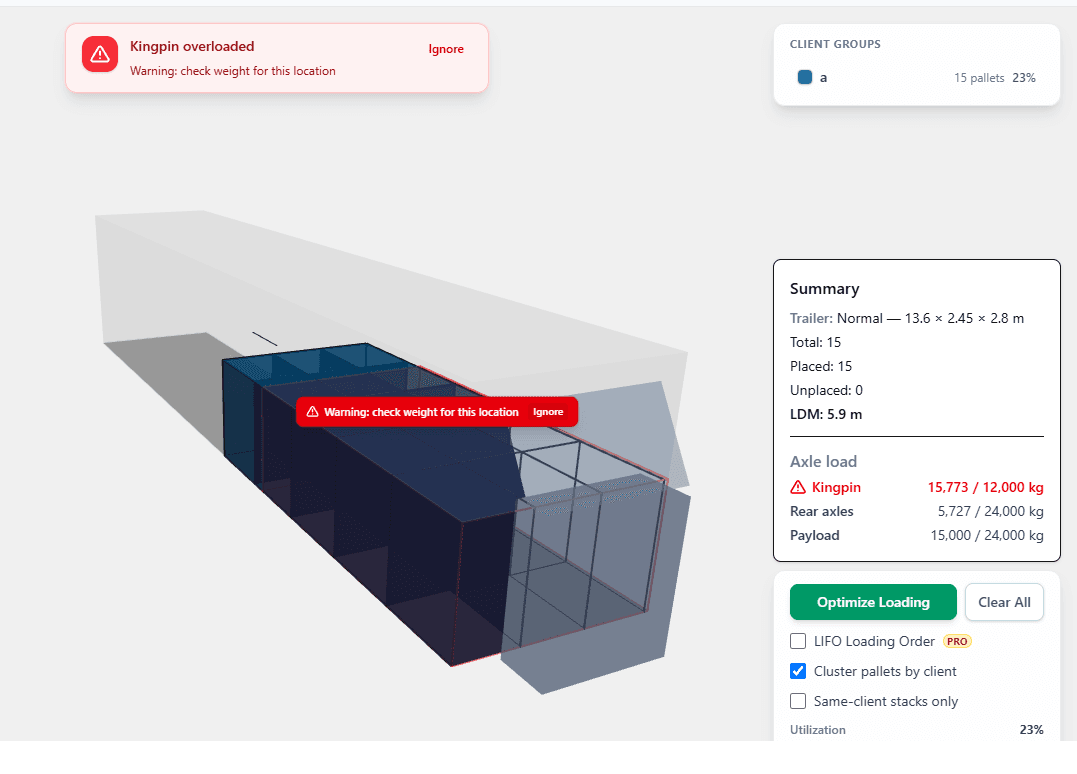
This is the failure mode worth planning for. A load can sit at 24 tonnes, comfortably legal on gross weight, and still put the kingpin over because too much of the freight is bunched forward. The weighbridge finds it either way. The difference is whether you find it first. Our guide to EU weight and size limits covers the national specifics for Germany, Poland and Estonia.
Where the plan file lives
For a forwarder answering a procurement questionnaire, data residency is usually a harder question than features. PalletPlan is operated by Nulliverse Capital OÜ, an Estonian company registered in Tallinn since 2024, reg. code 16146817, VAT EE102914463. Servers are in Frankfurt. Data stays in the EU and is never shared or sold.
What dispatchers use day to day
Auto-pack. A multi-pass deterministic search using a GRASP optimizer over extreme points, solving in under 200 ms. It ranks candidate plans on fewer leftover pallets, tighter space use, cleaner client zones and a EUR-friendly floor. The layout that crams in the most pallets does not always win.
Locks. Put the heavy machine where it has to go, pin it, and let auto-pack solve around it. Lock as many pallets as you need. Manual placements always win, which is what you want when part of the trailer is already physically loaded.
Stacking rules. Each pallet carries max_stack, can_stack_on and can_stack_below. The packer will leave a gap rather than break one, and any stacked pallet needs full footprint support underneath. An optional setting keeps stacks within a single client for operations that need freight physically separated.
Client groups and drop order. Groups get a colour, a drop order and per-group totals. LIFO scoring pulls the first drop towards the rear doors so the load unwinds in the right sequence over a multi-stop route.
The manifest PDF. A top-down view and a side elevation showing the stacking, every pallet labelled by customer, with per-client totals and a pallet count. It fits on a single A4 where it can. Print it, email it, or send it over WhatsApp.
What it does not do
Being specific about the gaps is more useful than a feature list:
- No TMS integration yet. JSON export and native connectors for Locus, Cargotor and custom systems are on the roadmap, not shipping.
- No multi-trailer optimization. One trailer at a time.
- No cargo-securing calculation. Lashing to EN 12195 and ADR segregation for dangerous goods are outside its scope.
- No centre-of-gravity optimization or fragility constraints beyond the stacking rules above.
- Delivery sequencing is LIFO only.
Pricing, in euros, with EU VAT handled
The free plan is free permanently: full 3D planner, auto-pack, PNG export and one saved plan. Pro is €14.99 per month for a single dispatcher seat, or €11.99 on annual billing, and adds unlimited plans, the custom pallet library, trailer presets, client groups and the driver loading sheet. Team is €9.99 per seat per month, €7.99 annually, with a three-seat minimum and centralized billing. Volume discounts start at ten seats: −10% at 10, −15% at 25, −20% at 50. Forwarders running ten or more dispatchers can also get SSO over SAML or OIDC, a self-hosted option for air-gapped sites, and a solution architect during onboarding.
VAT is calculated by Stripe Tax from your billing address. Supply a valid VAT number and EU or EEA businesses get a reverse-charge invoice; otherwise the local rate is added. Payment is by card, SEPA direct debit, or bank transfer on annual plans.
You can open the planner on the free plan, or read how it works for a walkthrough. Full plan details are on pricing.
Related reading
- How to load a trailer efficiently: the fundamentals of space use and load sequencing.
- Legal truck weight and size limits in the EU: the regulatory baseline behind the axle checks above.
- How the load optimization algorithm works: what auto-pack is actually doing.
Figures and prices are current as of September 2026. The limits described here are the regulatory baseline, not your vehicle's specific numbers, which come from its registration documents.